

Salto del pastor: the Canarian shepherd’s leap and its lanza
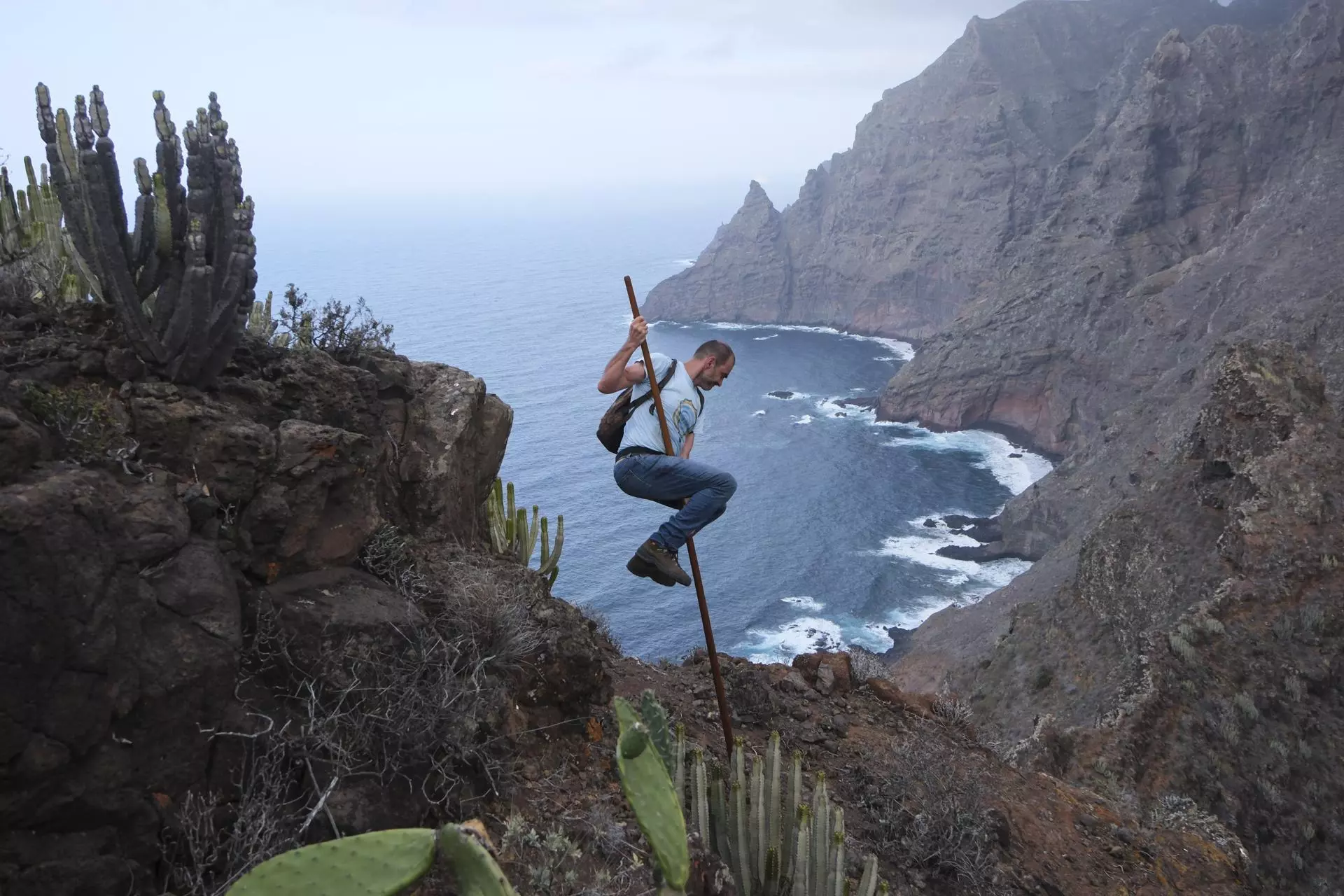
Picture a shepherd planting a long pole in a steep slope, pushing off and sliding to the bottom of the ravine in a few seconds. That is the salto del pastor, the shepherd’s leap: a practice born in the mountains of the Canary Islands that has become a sport in its own right. Here is what it is, how it works and what we really know about its link with the Guanches.
🎯 Key facts
- 🪵 The lanza: a pole 2 to 4 m long, most often made of Canary pine, with a metal tip.
- ⛰️ The idea: going down a steep slope or crossing a barranco by leaning on the pole.
- 🏛️ Origin: tradition links it to the Guanches, but it is poorly documented.
- 🏅 Today: a sport organised in clubs, the jurrías, and in a federation since 2001, and recognised as an Asset of Cultural Interest.
- 🧭 Not seen yet: I have not yet attended a demonstration in Tenerife.
What is the salto del pastor?
The salto del pastor, “shepherd’s leap” in English, is a way of getting around used by shepherds in the Canary Islands. With a long pole, they went down steep slopes and crossed ravines to follow their flocks in terrain where paths are scarce. Today it is also a sport, with fast descents, jumps, wall crossings and precision events.
The lanza, the shepherd’s pole
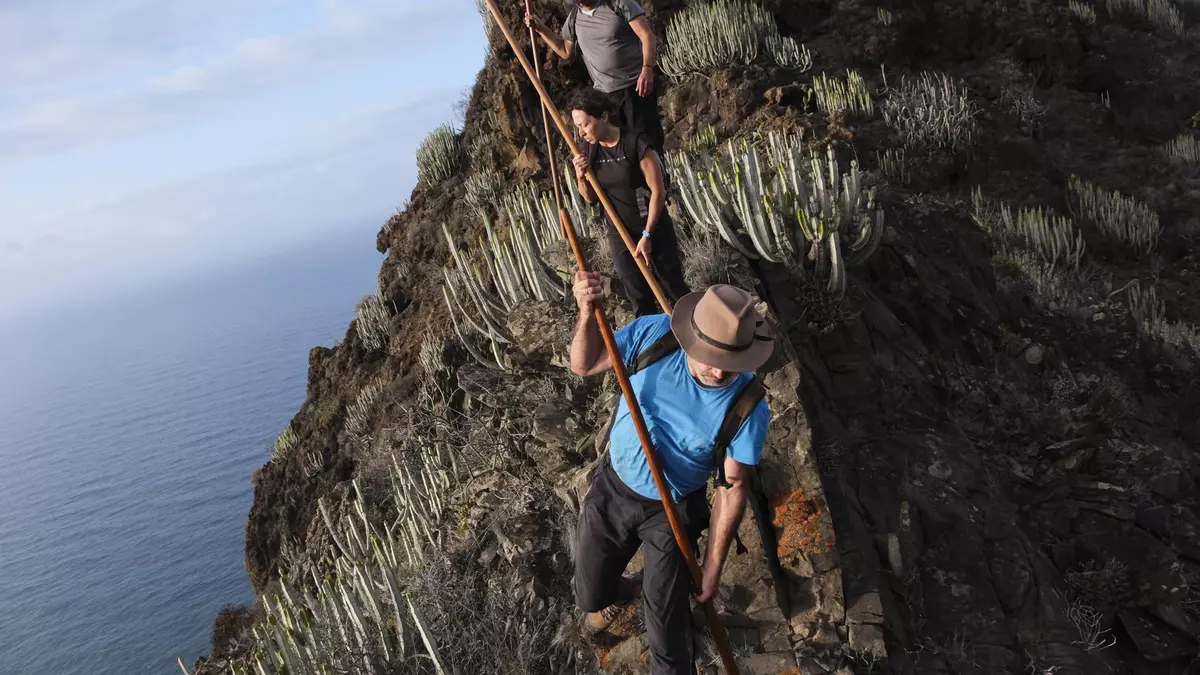
In Tenerife and La Palma the pole is called the lanza. Its name changes from island to island: garrote in Gran Canaria, lata in Lanzarote and Fuerteventura, astia or asta in La Gomera and El Hierro.
It is usually between 2 and 4 m long, longer in the mountains and shorter near the coast. Most often it is cut from Canary pine, thicker towards the bottom, and ends in a metal tip, the regatón, 14 to 38 cm long depending on the size of the pole. The story goes that before metal arrived, shepherds used a bone or a horn: that is tradition, not a documented fact.
How it works
There are two main ways to use it. The most common is to plant the tip in the ground, hold the top of the pole with one hand, place the other hand lower down with the palm up, then let yourself slide down, with the lower arm straight and the upper arm bent.
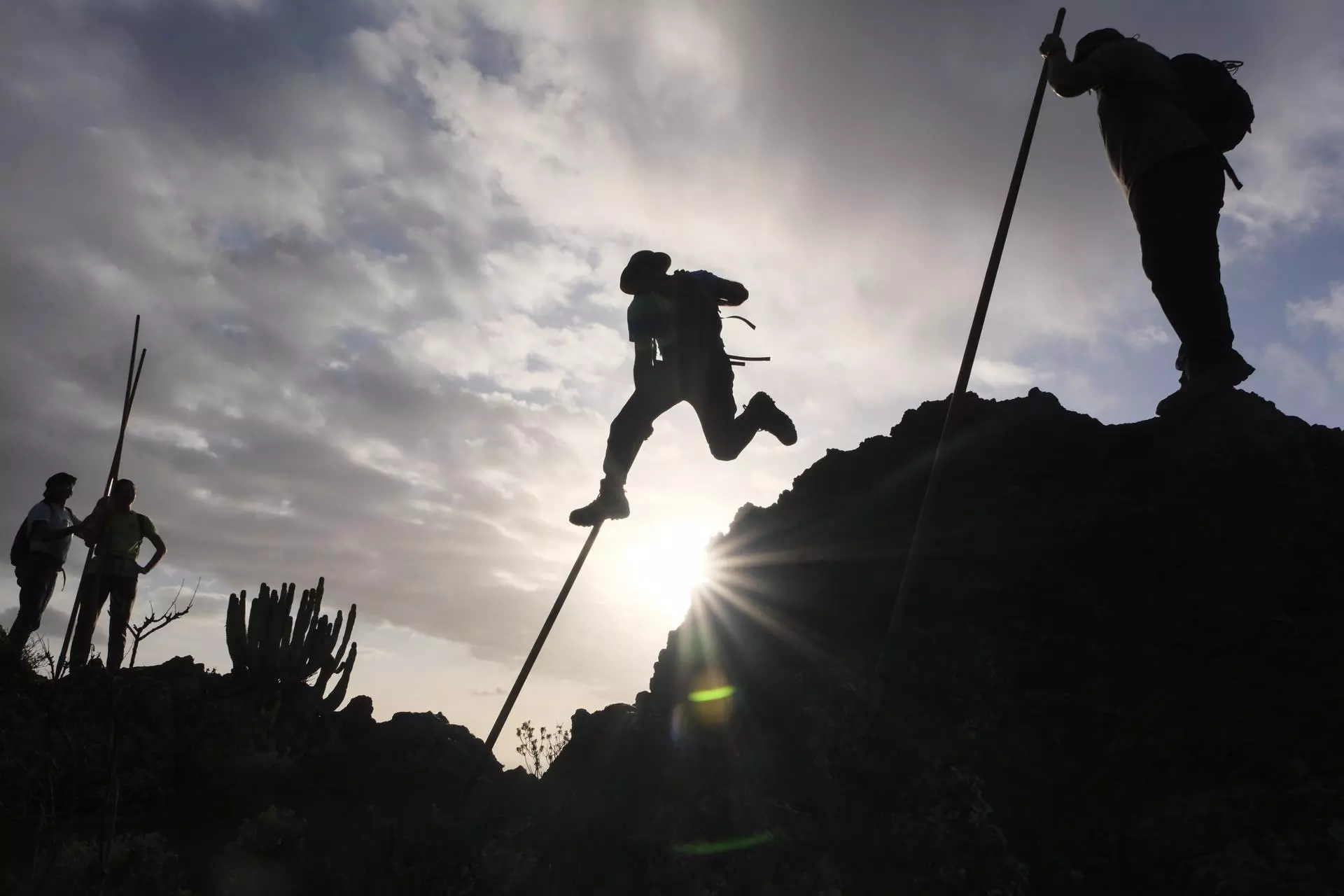
The second is the spectacular jump: you launch yourself into the void from a height that can reach about twice the length of the pole, without the pole touching the ground during the fall. Either way, it takes technique and training. A bad landing can end badly: this is not something to improvise on a hike.
A Guanche heritage?
That is what is most often said: the island’s first shepherds, the Guanches in Tenerife, are supposed to have invented this way of moving. Several texts repeat it, but no excavation or specific ancient text is cited to prove it. What is better documented is the practice in the 19th century: the British traveller Charles Edwardes described, in La Palma in 1888, peasants who always carry a long wooden pole with a spike, a description picked up by the official Canary Islands tourism portal.
From shepherd to sport: the jurrías
In the 1990s the practice left the mountains and became a sport. The first clubs, the jurrías, appeared from 1994, and the Canarian Shepherd’s Leap Federation was founded in 2001. There are now more than twenty jurrías across the archipelago. The Government of the Canary Islands has also declared the practice an Asset of Cultural Interest.
In Tenerife, the Aguere group, founded in 1994, celebrated its 30th anniversary in 2024 by walking through the Anaga massif with their lanzas. To get a feel for the terrain where this practice was born, the Anaga trails such as Cruz del Carmen to Punta del Hidalgo or Afur to Taganana show these slopes and ravines well.
Can you see or try the salto del pastor in Tenerife?
The clubs organise meetings and demonstrations, and the dates change from year to year. As far as I know, no introductory activity is offered to visitors. If you are curious, the easiest way is to go through the Canarian federation or one of the island’s clubs.
🧭 Not seen yet
I have not yet attended a salto del pastor demonstration. This page is here to explain what it is before you one day come across someone with a lanza in the island’s mountains. I will update it once I have seen one.
Going further
If you like the island’s history before the conquest, read our pages on Candelaria and its basilica, where you come across the Guanche heritage, and on gofio, the staple food inherited from the Guanches. To walk in the island’s mountains with the right equipment, see our guide to mandatory hiking gear.
Frequently asked questions
What does salto del pastor mean?
“Shepherd’s leap” in Spanish. It is a technique used by Canary Islands shepherds, who use a long pole to go down slopes and cross ravines, and it has become a sport.
What is the pole used in the salto del pastor called?
In Tenerife it is the lanza. Depending on the island it is also called garrote (Gran Canaria), lata (Lanzarote and Fuerteventura), astia or asta (La Gomera and El Hierro).
Does the salto del pastor come from the Guanches?
That is what tradition says, but the exact origin is poorly documented. The practice was described by travellers in the 19th century and has been organised in clubs since the 1990s.
Can you try the salto del pastor in Tenerife?
As far as I know, no introductory activity is offered to visitors. The clubs and the Canarian federation organise meetings and demonstrations.
Cover photo and illustrations: El Diario.