Canarian vocabulary: all the words to know before going to Tenerife
Even though everyone speaks Spanish in Tenerife, you will quickly notice that it is not quite the Spanish you learn at school or hear in Madrid. The Canarian accent has its quirks, but above all, the island has kept a whole vocabulary of its own: words inherited from the Guanches, others brought back by Canarians who went to live in Latin America, and a few expressions that are literally not said anywhere else in Spain.
Here are the words you will come across most often during your stay, enough to understand a restaurant menu, a sign or a conversation without looking completely lost.
🎯 The most useful words to know
🚌 Guagua: the bus
🥔 Papas: potatoes (never “patatas” here)
🌾 Gofio: toasted cereal flour, the island’s emblematic food
🏜️ Calima: the sand-laden wind blowing in from the Sahara
😮 Chacho: an all-purpose interjection, the equivalent of “wow” or “hey”
Getting around
The most useful word to know as soon as you arrive is “guagua”: that is what the bus is called in Tenerife, and in the Canary Islands more broadly. The origin is said to be an old American bus company whose name was picked up in the Caribbean and then brought to the island. You will never hear the word “autobús” in everyday use, so you may as well get used to it right away if you plan to use public transport.
On your plate
On a restaurant menu, potatoes are called “papas” and not “patatas” as on the mainland, especially in the emblematic dish “papas arrugadas”, small potatoes boiled in very salty water that leaves a thin film of salt on the skin. They are eaten with “mojo”, a typical sauce that comes in two versions: mojo rojo (spicy, made with red pepper and chilli) and mojo verde (made with coriander or parsley).
“Gofio”, already covered in detail in our dedicated article, is the toasted cereal flour that goes as well with breakfast as with a savoury dish. Maize is called “millo” rather than “maíz” in some local expressions, notably for gofio de millo. If you order a coffee with milk and a splash of liqueur, you are drinking a “barraquito”, a speciality we came across in our article on the Las Goteras guachinche. And a “guachinche” is one of those small family-run restaurants, often set up in a garage or a cellar, that serve the most authentic Canarian cooking: we have tried several in our Local food section. To find out what is in the dishes you will see on menus, check our guide to the specialities of Tenerife.
Landscape and weather
A “barranco” is a deep ravine carved by erosion into the island’s volcanic terrain: you will come across this word in many place names, such as the Barranco de Masca in the Teno massif. A “roque” is an isolated rock or volcanic peak, often an emblematic feature of a landscape (the Roque Nublo, well known on Gran Canaria, is the most famous example). The “malpaís” (literally “bad land”) is an area of old lava flow, hard to farm and often left wild.
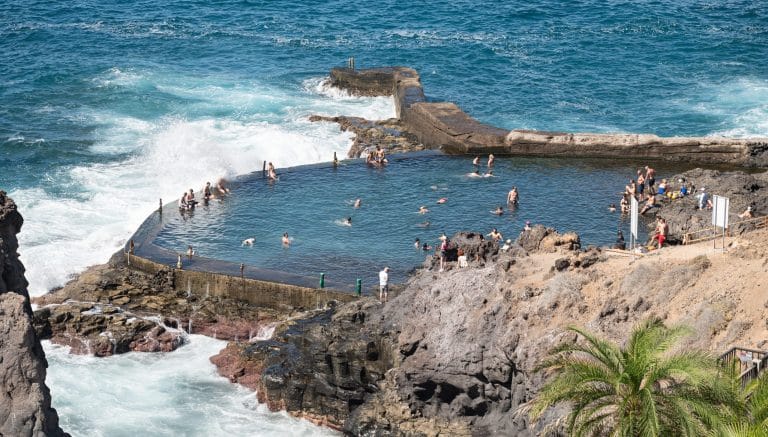
A “charco” is a natural pool or a pool of sea water formed in the volcanic rock: you have probably already seen this word in several of our articles on the natural pools of the north of the island. Finally, the “calima” is that hot, sand-laden wind blowing straight in from the Sahara, which veils the sky, reduces visibility and can irritate the eyes and throat for a few days. It happens several times a year, mostly in winter, and if you run into one during your stay, it is best to limit outdoor activities and stay well hydrated until it clears, usually within three to five days.
Culture and festivals
If someone mentions a “romería”, it is a traditional festival that blends a religious procession with a popular celebration, with decorated carts pulled by oxen: we have devoted a full article to it so you can understand everything if you are lucky enough to come across one. Participants in traditional costume are called “magos”, the name historically given to Canarian farmers, and the folk music groups that liven up these festivals are called “parrandas”.
Finally, “chacho” (sometimes shortened to “chó”) is an interjection you will hear everywhere, used in all sorts of ways to express surprise, annoyance or enthusiasm, a bit like “wow” or “hey” in English. It is often the word that gives away a real Canarian in conversation the fastest.
What is a guagua?
It is the word used in the Canary Islands for a bus. You will never hear the word autobús used in everyday life on the island.
What is the calima?
A hot, sand-laden wind from the Sahara that veils the sky and reduces visibility for a few days, several times a year, mostly in winter.
What is a romería?
A traditional Canarian festival that blends a religious procession with a popular celebration, with decorated carts pulled by oxen, music and dancing.
Why do people say papas and not patatas in Tenerife?
It is a quirk of Canarian vocabulary: potatoes are called papas, notably in the typical dish papas arrugadas, rather than patatas as on mainland Spain.
What is a charco?
A natural pool or a pool of sea water formed in the volcanic rock, a word you find in many place names on the island.