

Sunset at the Summit of Teide: a 5-Hour Hike for an Incredible Show
5 hours of hiking, 3,715 metres of altitude, a sunset above the clouds and a descent in the dark.
I had already climbed to the summit of Teide once before. But that time it was at night, to watch the sunrise.
This time I wanted to experience it the other way round: set off in the afternoon, climb up at a steady pace and watch the sunset from the highest point in Tenerife.
And I can already tell you: the view has to be earned.
🎯 At a glance
📍 Start: Montaña Blanca
⏱️ Climbing time: about 5 hours
⛰️ Altitude: 3,715 m, the summit of Teide
🌌 Descent: at night, on foot (no cable car after closing time)
🎫 Permit: compulsory, to be booked well in advance
📍 Distance: about 19 km round trip
📍 Elevation gain: about 1,400 m
📈 Elevation profile
about 19 km round trip · about 1,400 m of elevation gain · GPS track from 22 May 2026
Profile based on the GPS track recorded during the hike (start and finish at around 2,360 m, out and back by the same path, so the descent mirrors the climb). The summit altitude is aligned with Teide’s official value (3,715 m).
Contents
Setting off in the afternoon to arrive for sunset
Everything was calculated.
I left Montaña Blanca at around 2:30 pm, aiming to reach the summit at around 8 pm, just in time for the sunset.
You could of course leave later, but personally I preferred to have some margin. I didn’t want to spend the last hours staring at my watch, wondering whether I would make it in time.
In the end, I reached the summit at around 7:50 pm, after about 5 hours of hiking, including a few breaks.
The pace was pretty good, but I didn’t try to run either.
The idea was mostly to enjoy the climb.
And the path lets you take the time to look around.
A hike where the landscape keeps changing
It’s one of the things I like most about this climb up Teide.
You don’t walk through the same landscape for 5 hours.
At the start, the hike is fairly gentle. It climbs, but gradually.
Then the scenery becomes more and more volcanic.
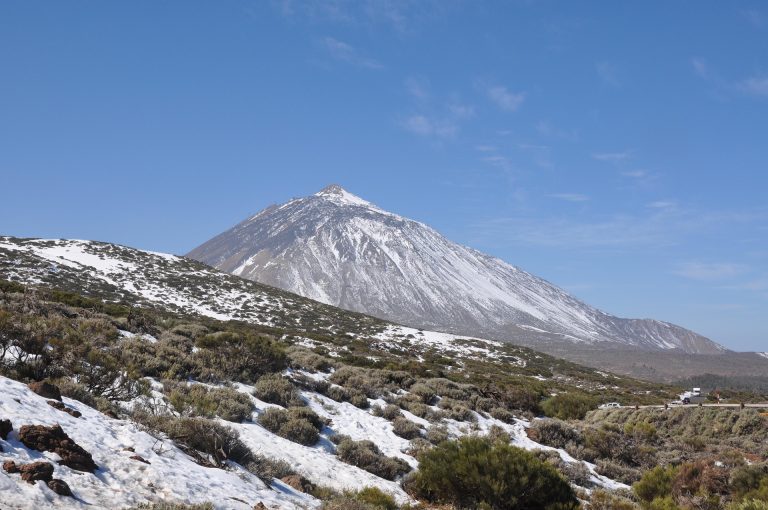
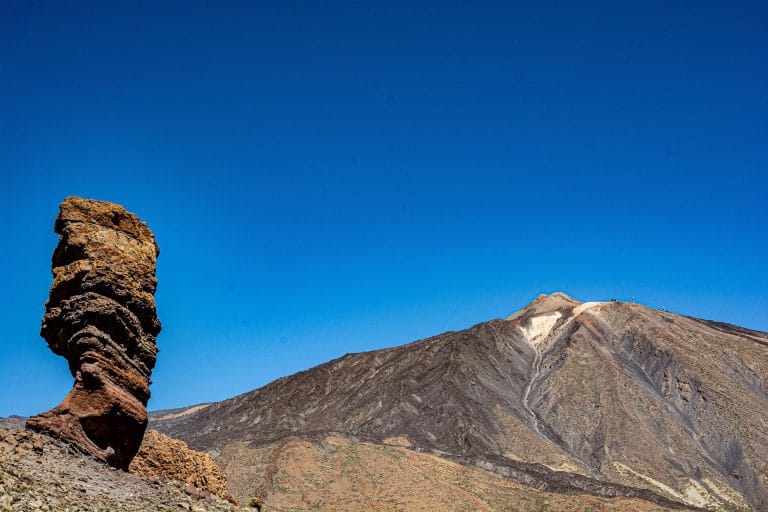
You cross areas of volcanic rock, stretches of pale sand, passages full of lava and completely desert sections.
The higher you go, the more mineral the landscape becomes.
And all along the way, the view gradually opens up over Tenerife and over that famous sea of clouds that sometimes surrounds the island.
That’s what makes the hike so interesting: you almost feel like you are changing planet as you gain altitude.
Then comes the serious part
The first part of the hike is quite accessible.
But at some point, you really start attacking the mountain.
And from there, it’s a different story.
The slope gets properly steep and some sections look almost like staircases made of rocks.
This is also when you start to feel the altitude.
You get a bit short of breath.
It isn’t necessarily painful or overwhelming, but you clearly feel you are no longer at coastal altitude.
You simply have to find your rhythm and keep going.
Personally, this time I didn’t have any major difficulty. But after several hours of climbing, one thing becomes quite obvious:
you can’t wait to get there.
La Rambleta: the hardest part is behind you
Arriving at La Rambleta is a relief.
You know you have already done a big part of the work and that only one last effort remains to reach the summit.
But that last effort is a special one.
At over 3,500 metres, every climb feels harder.
You move more slowly, you control your breathing more, and above all you start to realise you are really close to the top.
And then the final stretch finally arrives.
A few minutes later…
3,715 metres.
The summit of Teide.
Wow.
3,715 metres: arriving at the summit
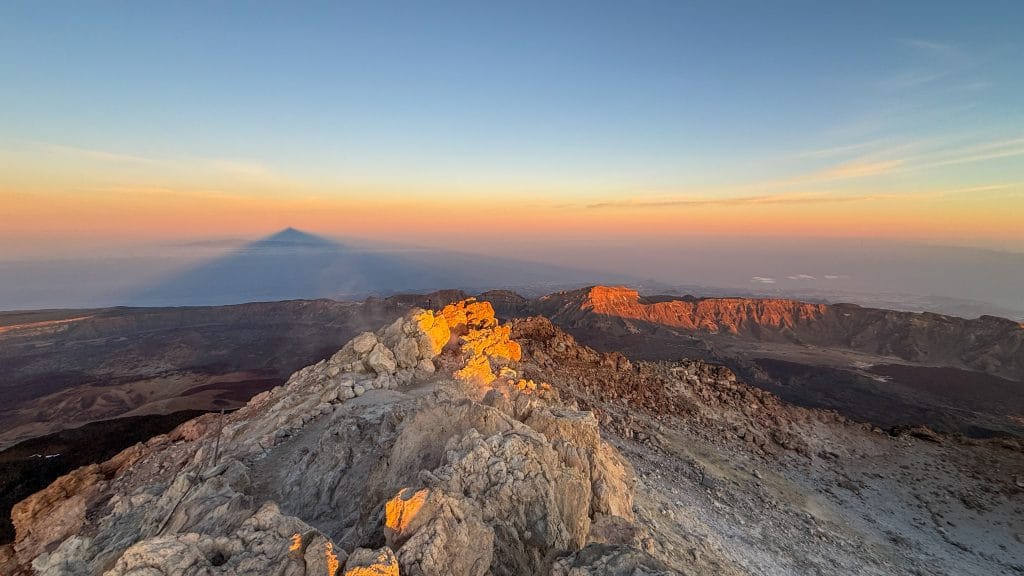
That was really my first reaction.
There was of course the tiredness after about 5 hours of hiking.
But above all, the feeling of having arrived somewhere completely different.
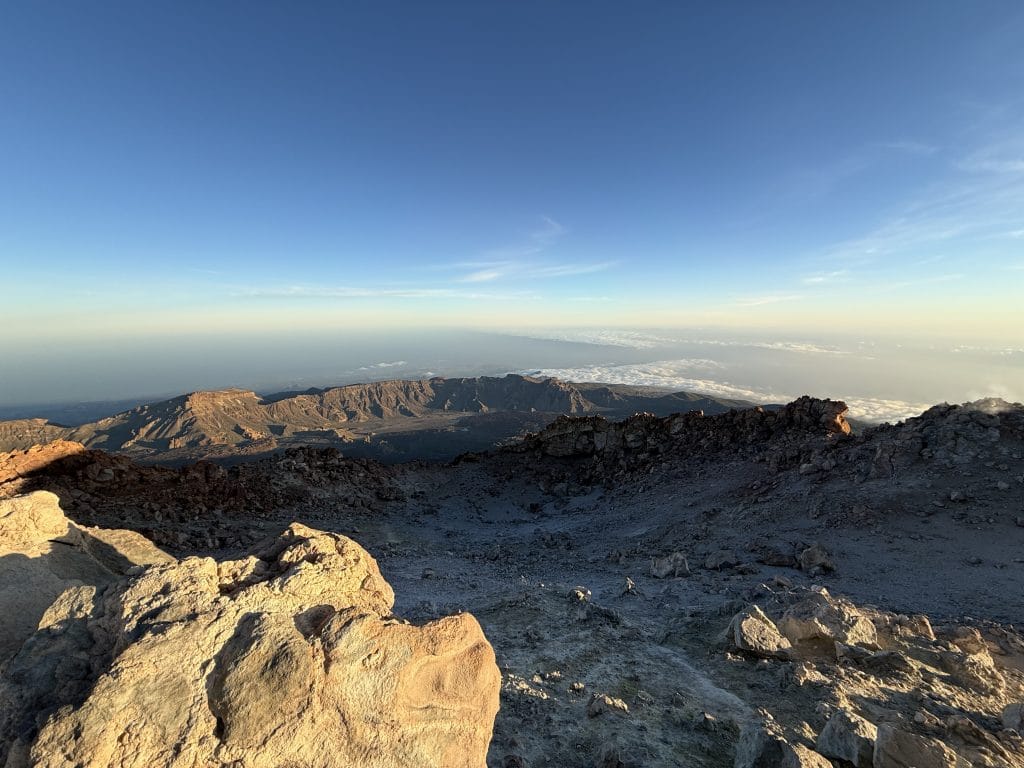
The view is immense.
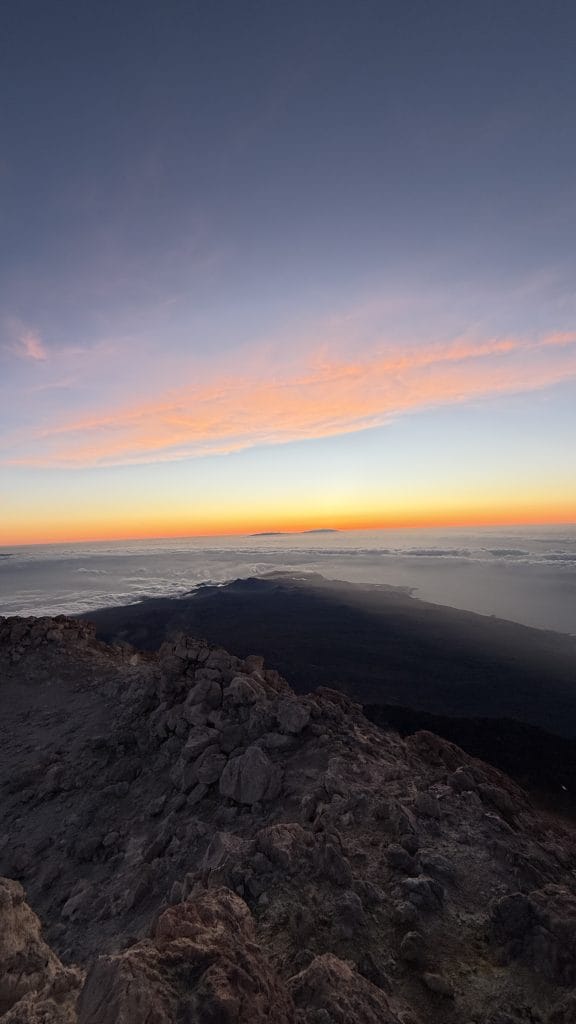
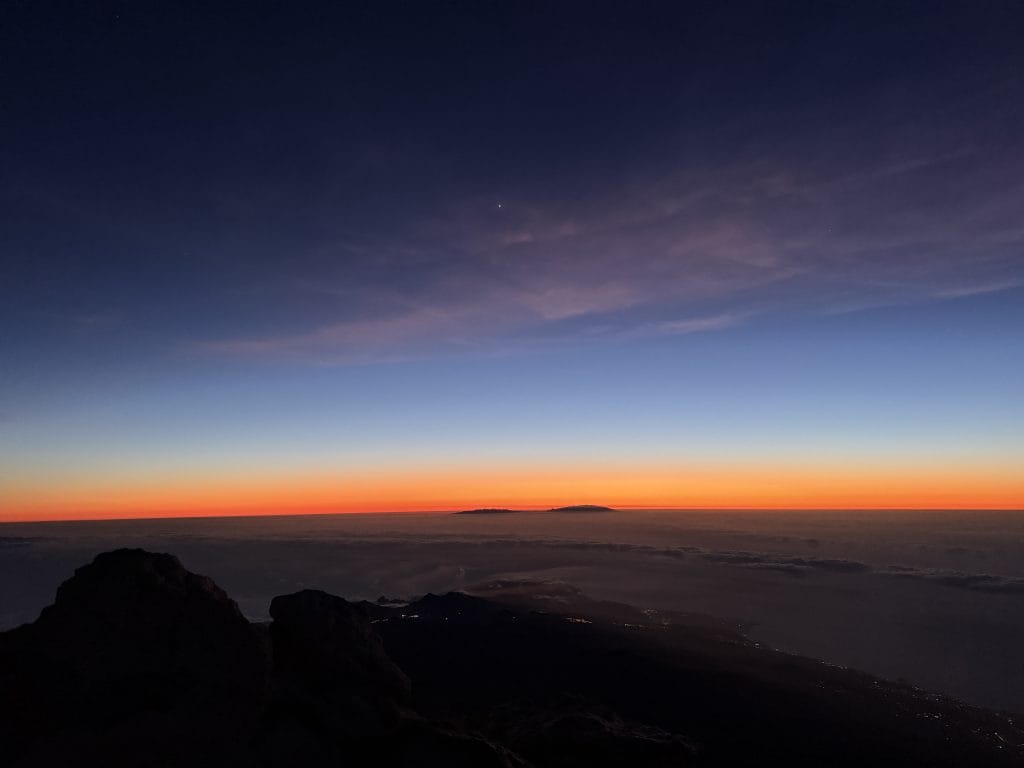
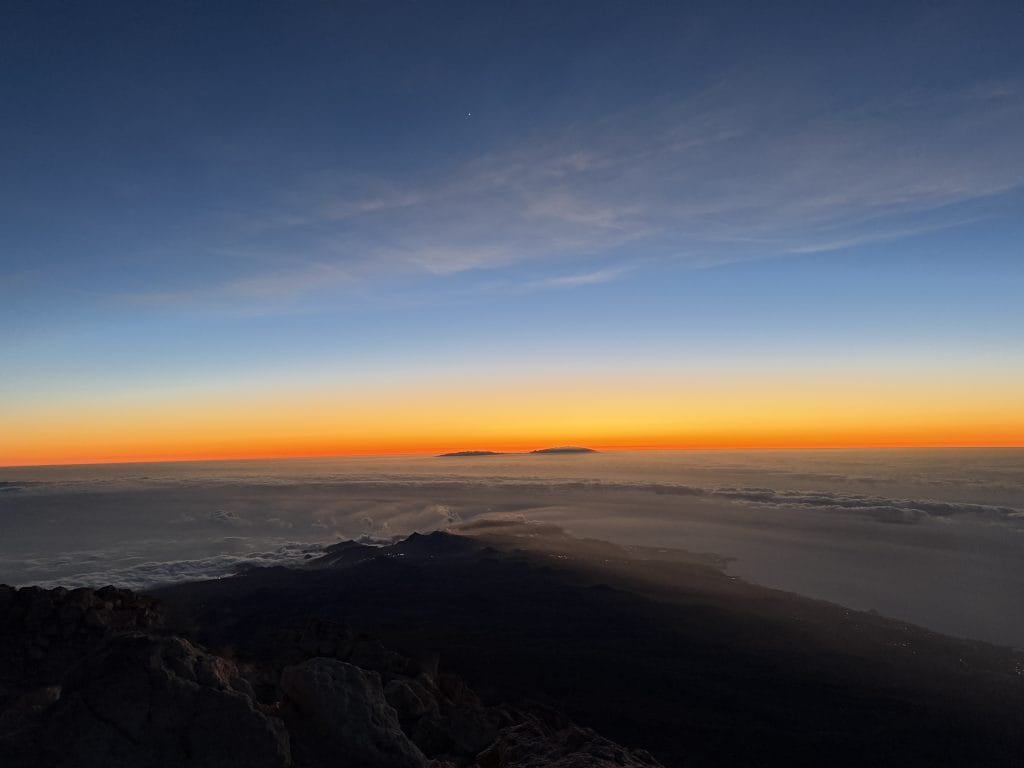
You can see practically all of Tenerife below you, the sea of clouds in the distance and, when conditions are good, the silhouettes of the other islands of the archipelago.
But what struck me most that evening was the scenery around the summit.
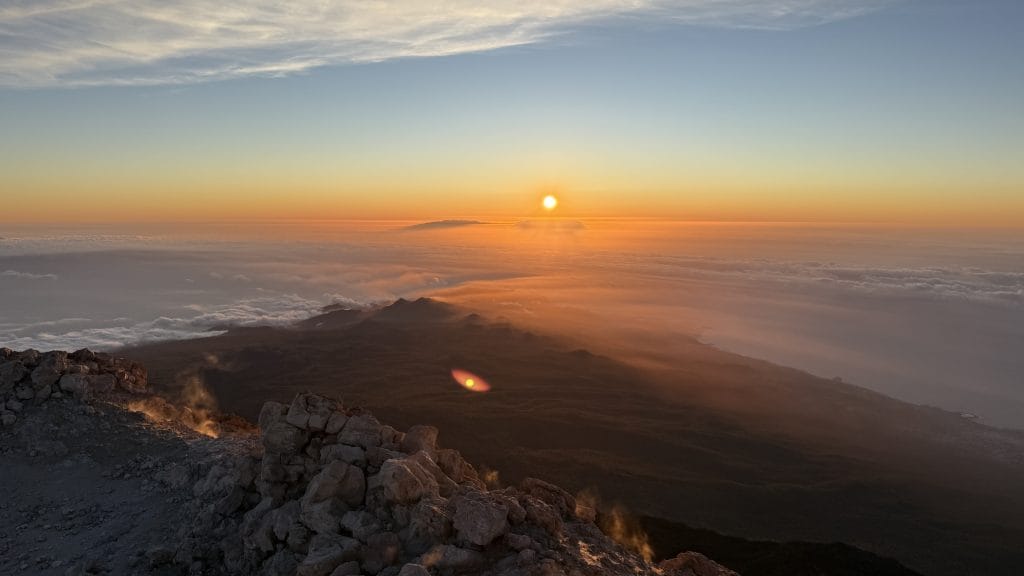
The fumaroles were very visible.
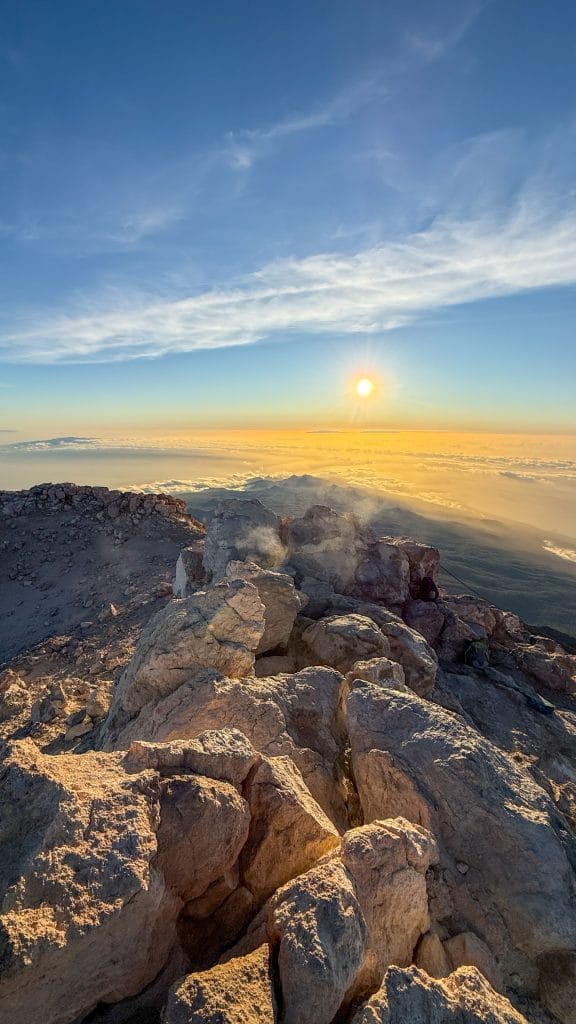
You can see them escaping from the volcano and you can also clearly smell the sulphur.
And then there is something photos can’t really convey:
the silence.
There were only a few of us at the summit that evening.
No crowds.
No noise.
Just the volcano, the fumaroles, the mountains in the distance and the sun slowly starting to go down.
Sunset at the summit of Teide
And then the show begins.
The light changes gradually.
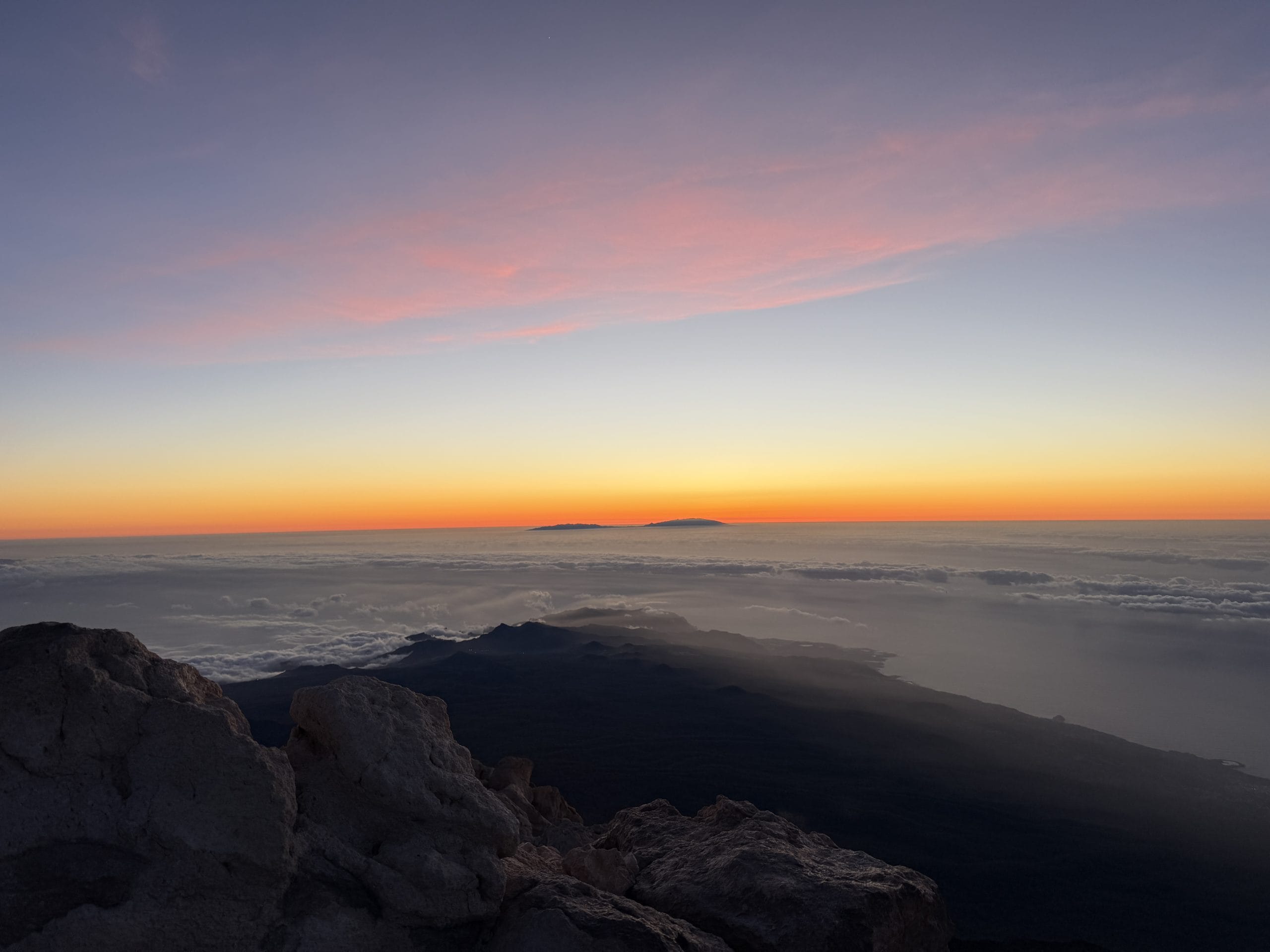
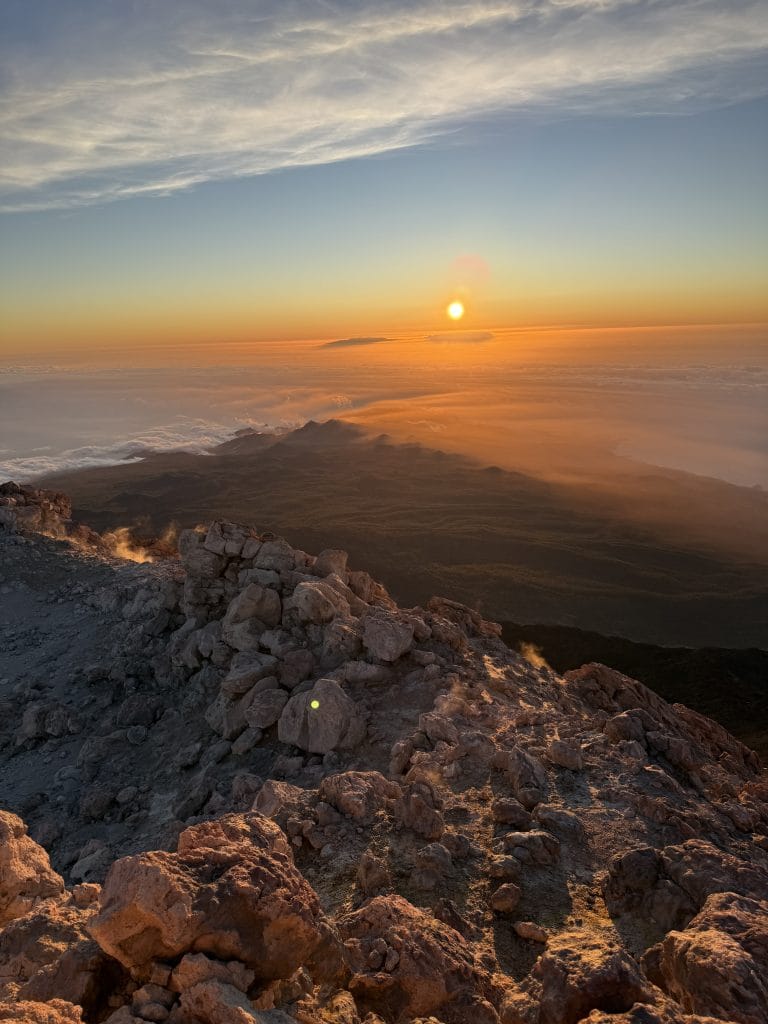
There was another detail I wasn’t expecting: the shadow of the volcano itself, cast far away onto the sea of clouds. A huge triangular shadow that stretches as the sun goes down, as if Teide were drawing its own silhouette in the sky.
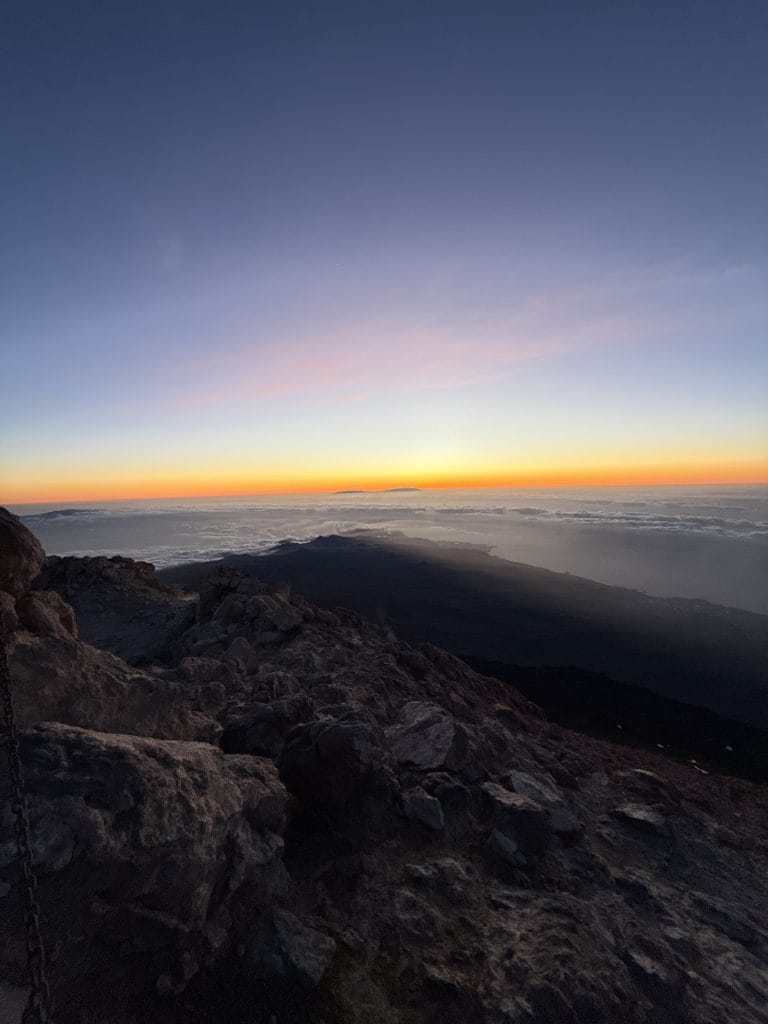
The volcanic landscape takes on completely different shades and the sky goes through several colours.
Orange, yellow, pink, red…
Everything transforms in a few minutes.
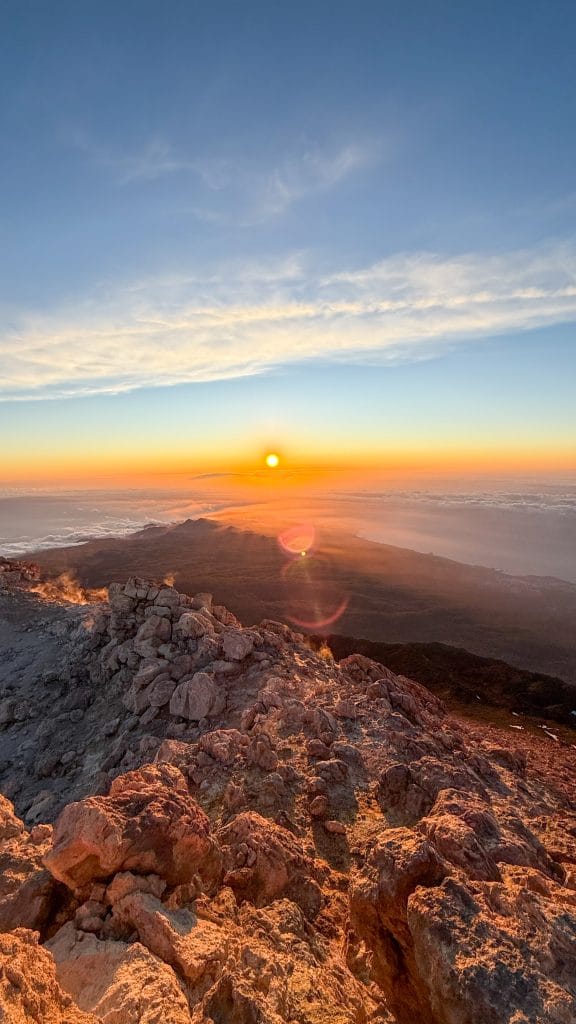
And the best part is that this time, I was able to stay until the very end.
I watched the sun disappear completely behind the horizon.
Not just the last minutes of a sunset.
The moment when the sun really disappears.
After walking for about 5 hours to get up there, it’s naturally quite special.
You watch the sun go down knowing that you will soon have to come back down the whole mountain in the dark.
But at that precise moment, you don’t really think about it.
You enjoy it.
An hour at the summit
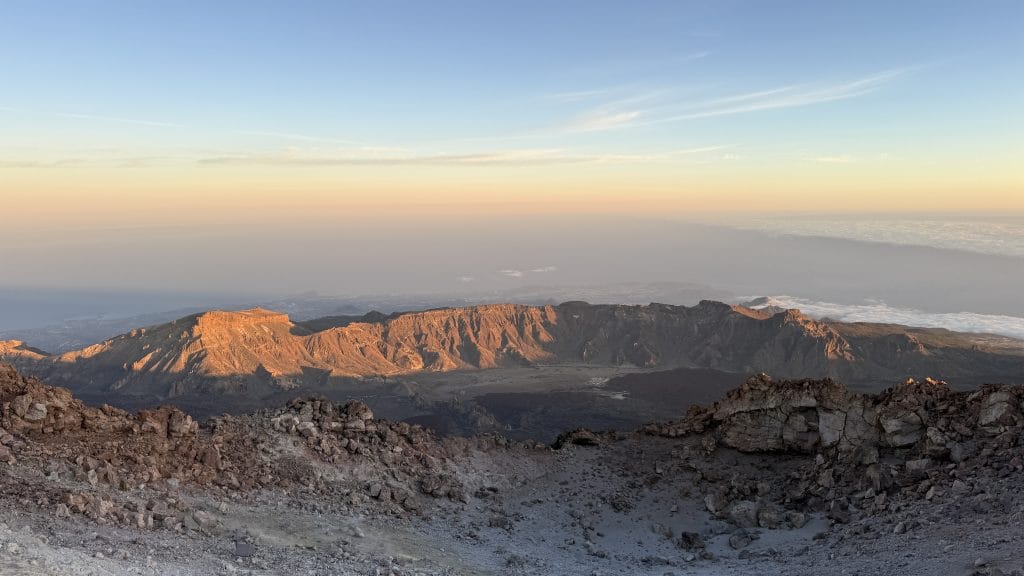
I stayed at the summit for about an hour to an hour and a quarter.
It was pretty mild when we arrived, with just a slight chill.
Once the sun had set, though, the temperature dropped quickly.
I had planned for it: down jacket, hat, gloves and suitable clothes.
We ate a sandwich, took a few photos and videos, chatted a bit with the other hikers…
That’s also what I loved about this experience.
After several hours of walking, you finally get up there and can simply sit down and enjoy the moment.
And now… time to go back down
This is the small detail you absolutely must think about before deciding to do the sunset at the summit of Teide.
You will be coming back down at night.
The cable car won’t be there to bring you back.
In our case, we started the descent at around 9:30 pm.
And in the end, I found this part rather nice.
The landscape you have just spent several hours crossing looks completely different in the dark.
The sky is clear, there is no wind and the atmosphere is almost unreal.
But of course you need to be much more careful.
The stones, the uneven sections, the tiredness and above all the darkness are unforgiving.
A good headlamp is essential.
And for a hike like this, an emergency blanket is also part of the gear to bring.
You really have to take this descent seriously and not try to go too fast.
The odd crossing with those climbing for sunrise
Near the end of our route, we met people who were starting their ascent to watch the sunrise.
It naturally reminded me of my first experience at the summit of Teide.
I had also done this hike at night to reach the summit in the early morning.
And it’s quite funny to see the two experiences cross paths.
Some were starting their adventure while we were already on the way back.
Is a sunset at the summit of Teide really worth the effort?
Yes. But not for everyone.
Let’s be honest: if you don’t like walking, this probably isn’t the experience I would recommend.
We are talking about roughly 5 hours of climbing, followed by a descent in the night.
So you need a minimum level of fitness and, above all, to be able to cope with several hours of hiking.
The altitude adds an extra difficulty too.
But if you really love hiking, I think it completely changes the way you discover Teide.
You don’t just go up to take a photo at the summit.
You earn that view.
And that’s probably what makes it even more impressive.
Sunset or sunrise?
Having done both, I find it an interesting comparison.
The sunrise means starting the hike at night, with a completely different atmosphere.
The sunset, on the other hand, lets you see the whole landscape during the climb.
You watch the volcano change gradually around you, you arrive while there is still daylight, you enjoy the sunset and then you come back down under the stars.
Personally, I would find it hard to choose.
The two experiences are very different.
But if you want to discover Teide in a different way from the cable car, the sunset is clearly an experience I recommend.
As long as you are ready to walk.
What to bring
If you are thinking of doing the same, don’t set off thinking it’s just a tourist stroll.
Bring at least:
- 🥾 Proper hiking boots
- 🧥 A warm jacket or down jacket
- 🧤 Gloves
- 🧢 A hat
- 🔦 A headlamp
- 💧 Enough water
- 🥪 Something to eat
- 🆘 An emergency blanket
- 📱 A charged phone
- 🧥 Several layers so you can adapt to temperature changes
And above all, don’t rely on the temperature at the seaside.
At 3,715 metres, conditions can be completely different.
The day I went, it was quite mild at sunset.
But as soon as the sun disappeared, the cold set in quickly.
Permits: to arrange before you go
Another essential point: you can’t simply decide to climb to the summit of Teide on the same day.
For the details of the trail up to La Rambleta (map, elevation profile, kilometres and PNT 07 rules), see our Montaña Blanca to La Rambleta fact sheet.
Access to the summit, in the heart of Teide National Park, is regulated and requires a permit.
For the route I took, you also have to take into account the permits and bookings linked to the different sections of the route.
So I recommend checking the access conditions and the bookings you need directly on the official platforms before planning your hike (I explain the process in detail in my article on the Teide summit permit).
And above all, don’t leave it to the last minute.
I booked about a month ahead for my ascent.
To find out what time the sun rises or sets depending on the month, see our table of sunrise and sunset times in Tenerife. And for another way to reach the summit, here is our account of the climb via Pico Viejo (PNT 09 + PNT 10), with a sunset and a summit at night.
Would I do it again?
Yes.
And that’s probably the best summary of this experience.
It was already my second time at the summit of Teide.
The first to see the sun rise.
The second to watch it disappear.
And I think I could do it again.
Because in the end, what stays with me is not only the sunset.
It’s the hike as a whole.
The changing landscapes.
The volcanic rocks.
The sea of clouds.
The breathing that gets harder.
The last metres where you really start to feel the altitude.
The fumaroles.
The smell of sulphur.
The complete silence at the summit.
And then that moment when the sun finally disappears.
After 5 hours of hiking, you really understand one thing: the view has to be earned.
And frankly, maybe that is exactly why it is so beautiful.
👉 Read also: Stargazing in Tenerife.
Do you need a permit to climb to the summit of Teide for the sunset?
Yes, access to the summit is regulated and requires a permit, to be booked in advance on the official platforms (about a month ahead, in my case). I explain the whole process in my article on the Teide summit permit.
How long does it take to climb to the summit of Teide from Montaña Blanca?
Allow about 5 hours of hiking to the summit, including a few breaks, without trying to run.
Can you come back down by cable car after the sunset?
No, the cable car no longer runs at that time. The descent is on foot and in the dark, with a headlamp essential and a good dose of caution.
What equipment do you need for this hike?
Proper hiking boots, a warm jacket or down jacket, gloves, a hat, a headlamp, water, food, an emergency blanket and a charged phone. The temperature at the summit has nothing to do with the seaside, especially once the sun has set.
Is it better to do the sunrise or the sunset at the summit of Teide?
They are very different. The sunrise means climbing at night, while the sunset lets you see the whole landscape during the climb and then come back down under the stars. Both are well worth the effort.
Is this hike suitable for everyone?
You need a minimum level of fitness: about 5 hours of climbing followed by a descent in the dark, with the altitude adding an extra difficulty. If you don’t like walking, this is probably not the experience to choose.